|
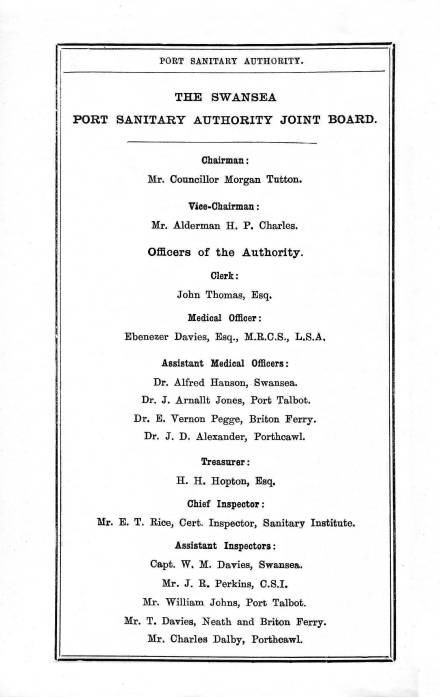
Swansea Port Health Authority
|
|
Port
Sanitary Authorities were first established under the
Public Health Act of 1872, and gained further statutory
powers under subsequent Acts of Parliament such as the
Infectious Disease (Notification) Act 1889 the Public
Health Act 1896. The principal role of a Port Sanitary
Authority was to prevent diseases such as cholera,
plague or yellow fever being spread to the local
populace through contact with crew members from
foreign-going ships by way of inspection and, if
necessary, enforced quarantine or hospitalisation
|
|
Renamed
‘Port Health Authorities’
under the Public Health Act 1936,
they remain responsible for a number of different
functions designed to protect environmental, public, and
animal health in the UK by preventing the spread of
infectious diseases, enforcing controls on imported
foodstuffs, and ensuring compliance
with European Union rules and international trading
standards. The offices of the Swansea Port Health
Authority were located at No. 10 Somerset Place until
the early 1970’s, when demolition of the area for
redevelopment necessitated a move to the present office
building alongside the Kings Dock Lock. Now known as the
Swansea Bay Port Health Authority, it is currently
responsible for the entire maritime area between Mumbles
Head and Porthcawl, including the ports of Swansea,
Neath and Port Talbot.
|
|
|
The Hecla
|
|
Interestingly, our friend and contributor
Ron Tovey – who is researching mid-nineteenth century
Swansea for a forthcoming book – tells us that the only
outbreak of yellow fever to occur in the UK was, in
fact, at Swansea in 1865. The disease was borne aboard
the ‘Hecla’ which was carrying copper ore from Santiago
de Cuba to Swansea, and is reported to have infected 22
people – 15 of whom died. Two of the deaths occurred in
Llanelli as a result of a sloop being tied up alongside
the ‘Hecla’ before sailing to Penclawdd. The official
dates of the epidemic were from 15th
September to 13th October 1865.
|
|
Septembers Unwelcome Guest
By Tom Ridd
|
|
|
|
THE
PILOT WH0 CAME Aboard the Hecla, a sailing-ship
bound from Cuba to Swansea with a cargo of copper ore, in
the sultry, stifling, near tropical heat of the morning
of the 9 September,1865, little realised that his charge
that morning was about to be the central figure in a
drama unparalleled in English sanitary history.
|
|
Outwardly,
it must be admitted, there was nothing aboard to suggest
that anything was seriously amiss and thus arouse his
suspicions. Unsuspecting, therefore, he accepted, as a
matter of mere
routine, the Master's report that a member of the Helca's crew was
suffering from dropsy and that three other members of the
ships crew had died during the homeward voyage. This;
as the pilot
well knew, was not an unusual occurrence aboard ships engaged
on the copper ore run to and from the tropics; and
though the last
Cuban ship to dock at Swansea had not had a clean bill
of health
the pilot remained completely unsuspicious and did not enquire
searchingly into the nature of the three deaths that had occurred
aboard the Helca. No mention was made of yellow fever nor was
the slightest hint given that the sickness at present
aboard the Helca might be of an infectious nature. Consequently,
the Helca,
showing no quarantine flag, was moored alongside the Cobra
Wharf in the North Dock, and while gangs of dockers
began to
discharge her cargo, the crew went off to enjoy the
doubtful
pleasures afforded by the innumerable dingy public
houses which abounded
along Swansea`s infamous Strand in the nineteenth
century.
|
|
Emboldened by the inebriating effects of their beer some
of the
seamen began to talk indiscreetly and hint darkly that
their
colleagues who had died during the homeward voyage had
been the victims
of yellow fever. When these frightening revelations were
subsequently confirmed by the Helca's captain the
populace soon became
thoroughly alarmed. The Mayor, J. C. Richardson, even visited
the sick seaman only to find his worst fears confirmed. The man
was in a state of near exhaustion and his skin
distinctly yellow
in colour. He died shortly afterwards. The body was
immediately buried and the locality where he had lived
disinfected.
|
|
The
authorities in Swansea had good cause to be alarmed. They
were not unfamiliar with the ravages of epidemic disease
and knew
what fertile breeding grounds for disease still existed
in their midst
due to the lamentable inadequacy of their sanitary
administration
in the borough. Epidemic yellow fever, however, was
something thing
which they had never experienced. Nor had any local
authority, for that matter, in the whole of the British
Isles.
|
|
We thank The Gower Society and Tom Ridd
for allowing us to put this article on our site.
Also thanks to Ron Tovey for arranging it.
Article from Gower Volume 12 page 42 1959
|
|
|
|
|
 |
|
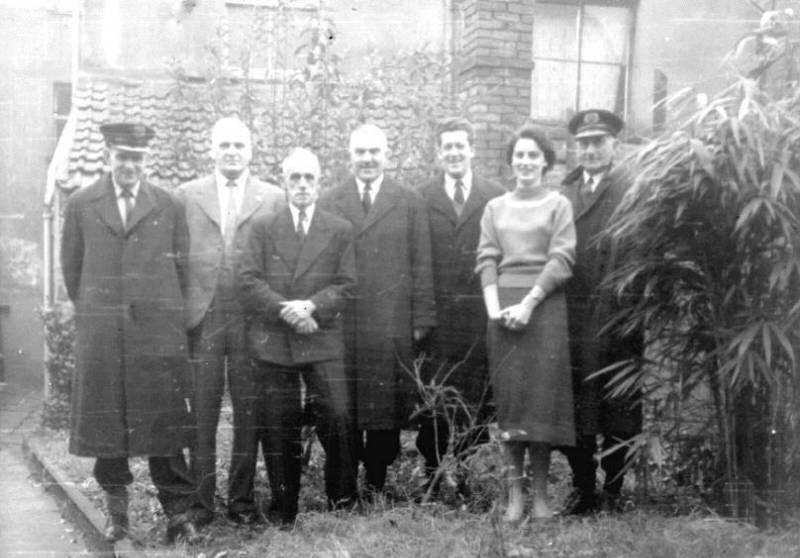
Staff of the Swansea Port Health Authority at the rear of
the Somerset Place office c.1959. Left to right:-
Cliff Owen,
Arthur Davies, Dan Jenkins, Tom Richards, John Prosser, Yvonne
David and Peter Jones
|
|
 |
|
Swansea Port Health Authority staff in the Somerset Place
office in the mid 1960's.
left to right, front row:- Dan
Jenkins, Yvonne David and Tom Richards, and
back row:- Peter
Jones, John Prosser, Cliff Owen and Arthur Davies
|
|
 |
| |
| |
|